ESG Strategy & Sustainability Reporting
Net Zero / SBTi roadmaps, TCFD climate risk assessments and ESG KPI frameworks with impact reporting for energy and industrial organisations.
Regulators, lenders, investors, and customers increasingly read sustainability disclosures alongside financial performance. Fluxiss builds ESG strategies grounded in engineering and operational evidence so reported commitments can be traced to what assets actually consume, emit, withstand, and deliver.
We connect corporate objectives with site-level data, capital planning, climate exposure, governance, and measurable delivery. That prevents sustainability reporting from becoming a separate narrative disconnected from engineering decisions and operating budgets.
What We Deliver
- Net Zero / SBTi Roadmaps - science-based target setting with a costed decarbonisation pathway.
- TCFD Climate Risk Assessment - physical and transition risk analysis mapped to your asset base.
- ESG KPI Framework & Impact Reporting - measurable indicators and reporting structures aligned with your disclosure obligations.

Auditable Emissions Baseline and Materiality
A credible strategy starts with organizational and operational boundaries that match the way the business is controlled. Fluxiss maps facilities, energy systems, fleets, purchased electricity, fuels, refrigerants, process emissions, logistics, products, and material value-chain categories into a consistent data structure with named owners and evidence sources.
Activity data, emission factors, estimation methods, exclusions, and uncertainty are documented. Material topics are evaluated using business impact and stakeholder significance, then linked to the assets, decisions, and policies that can influence performance. This creates a baseline that can be recalculated when acquisitions, disposals, methodology changes, or better data affect comparability.
- Scope 1, Scope 2, and relevant Scope 3 source mapping.
- Energy, water, waste, safety, workforce, supply-chain, and governance indicators.
- Data controls, calculation files, evidence registers, and audit-ready methodology notes.

Climate Risk at Asset Level
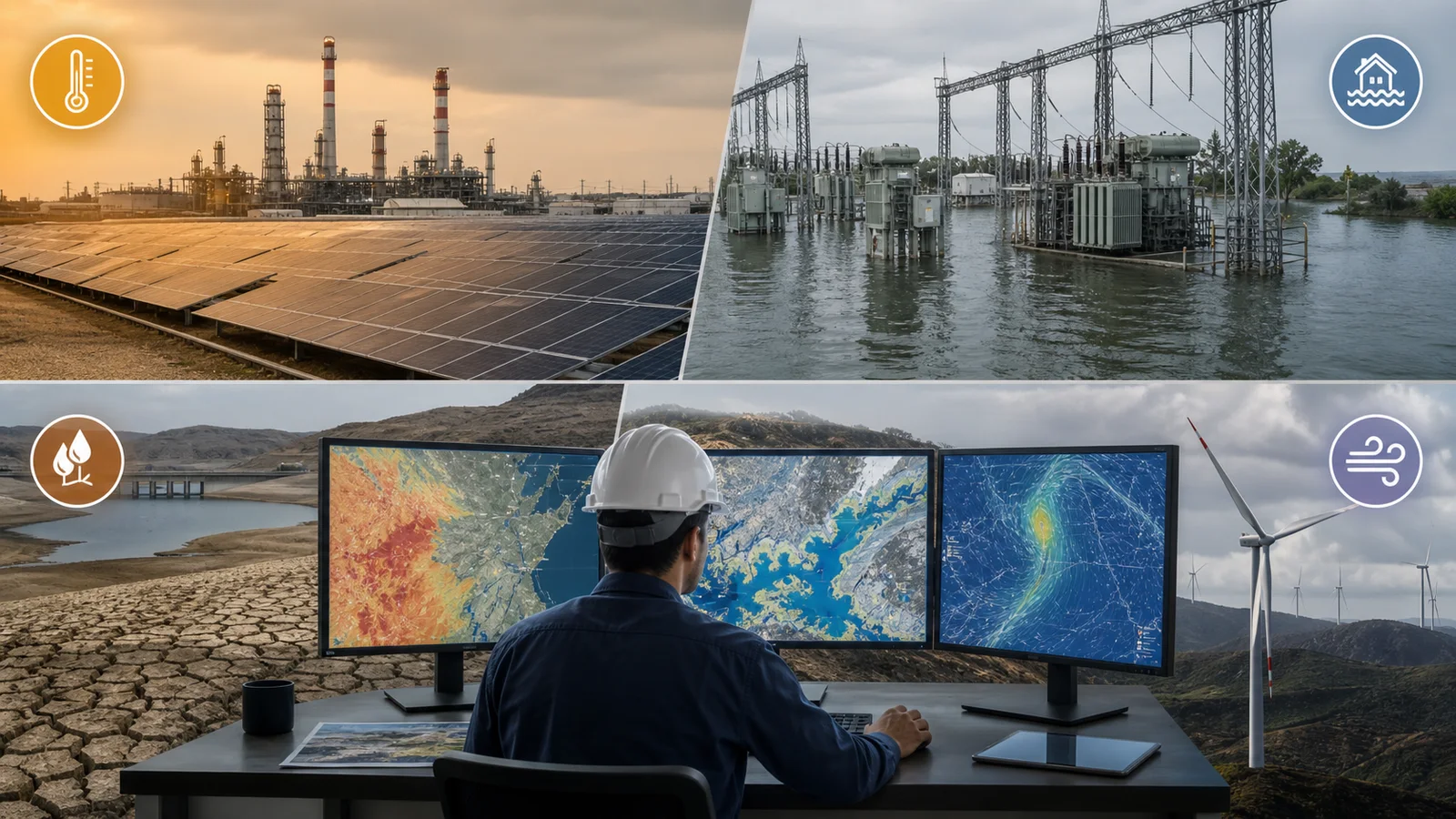
Corporate climate risk becomes useful only when it reaches physical assets and decisions. We screen locations and critical infrastructure for heat, flood, water stress, wildfire, wind, coastal, and other relevant hazards across selected time horizons and climate scenarios. Exposure is combined with asset sensitivity, existing protection, operational criticality, and recovery capability.
Transition risks such as energy price, carbon cost, technology change, customer requirements, insurance, and regulation are assessed alongside physical risks. Priority risks are translated into engineering studies, adaptation measures, business-continuity actions, ownership, timing, and cost ranges rather than left as qualitative heat-map entries.
- Asset screening and deeper assessment for material sites and systems.
- Scenario-based risk, opportunity, resilience, and adaptation analysis.
- Recommended controls tied to capital plans, maintenance, design standards, and insurance.
A Costed Decarbonisation Roadmap
Targets need a delivery pathway. Fluxiss builds a hierarchy of operational control, energy efficiency, heat recovery, electrification, renewable procurement, onsite generation, storage, fuel switching, process change, material efficiency, and credible residual-emissions treatment. Each measure is connected to technical feasibility, dependencies, timing, capital cost, operating impact, energy and carbon savings, and implementation ownership.
Projects are sequenced around asset life, planned shutdowns, grid capacity, technology readiness, lease or contract dates, and budget cycles. Marginal abatement cost and scenario analysis help distinguish no-regret measures from longer-term options that depend on policy, energy prices, or technology development.
- Near-, medium-, and long-term initiatives with accountable owners and decision gates.
- Energy, emissions, CapEx, OpEx, payback, risk, and co-benefit assessment.
- Progress pathway aligned with the chosen target and reporting boundary.

Reporting, Governance and Assurance Readiness
We define KPI owners, reporting frequency, calculation rules, evidence retention, controls, restatement policy, and management review. Disclosures are mapped to the frameworks and jurisdictional requirements selected by the client, while avoiding unsupported claims that exceed the available evidence.
The result is an ESG data pack, strategy, climate-risk register, costed roadmap, governance model, KPI dashboard specification, and reporting narrative that can withstand management, lender, investor, and assurance review. Start Your ESG Roadmap

Let's Build Something Great Together.
Partner with Fluxiss for engineering that holds up - under pressure, under load, under scrutiny.