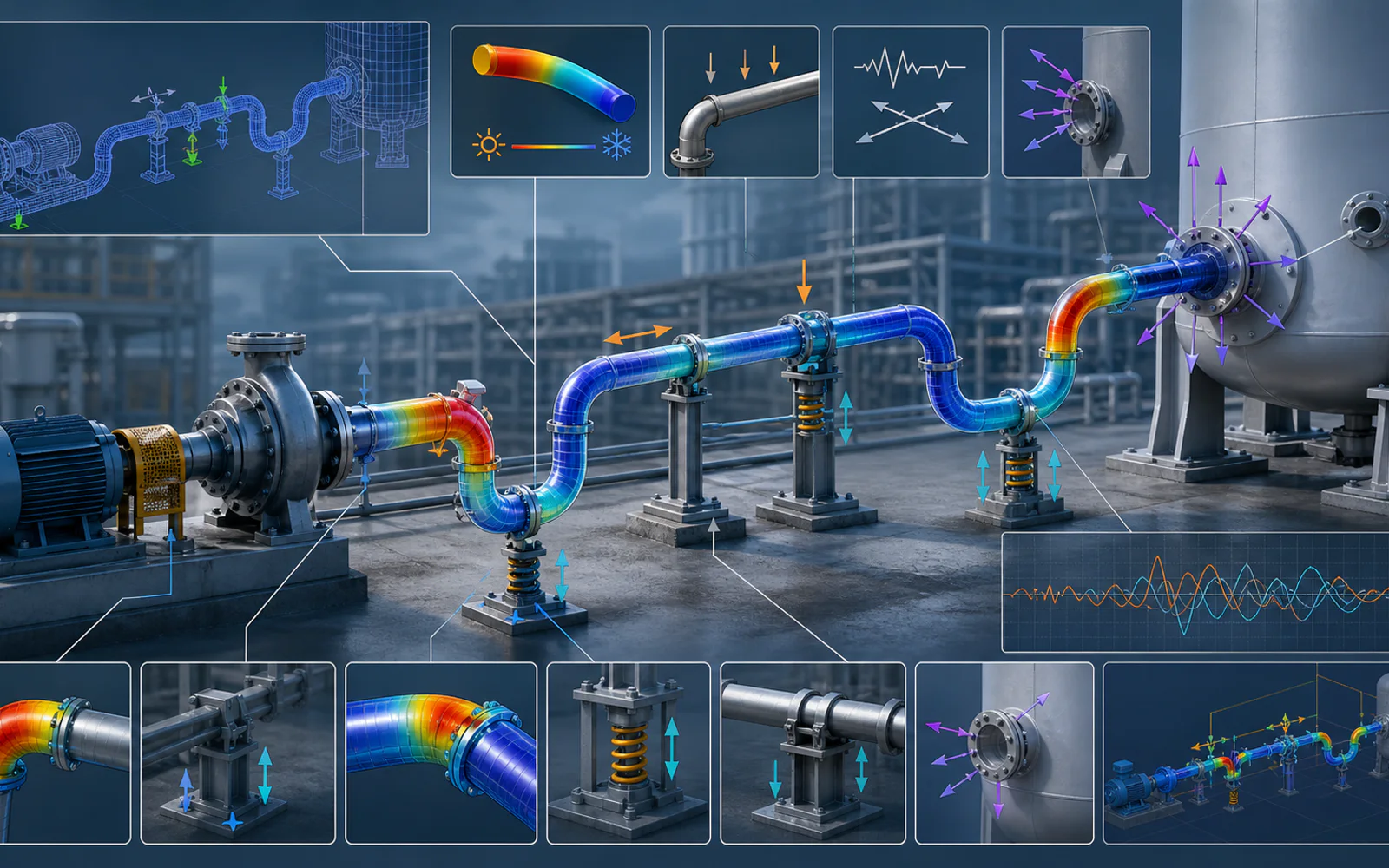
Pipe stress analysis is the engineering discipline that proves a piping system will survive everything the plant will throw at it - thermal expansion, internal pressure, its own weight, wind, earthquake, water hammer and the loads it imposes on pumps, vessels and structures. In practice it means building a calculation model of the piping, applying every credible load combination required by the governing code, and demonstrating that stresses, deflections and equipment nozzle loads all stay within allowable limits.
The codes drive everything. ASME B31.3 governs most process piping and defines three fundamental stress checks: sustained (weight plus pressure), displacement or expansion (thermal cycling), and occasional (wind, seismic, relief valve thrust). ASME B31.1 covers power piping, while European projects typically run to EN 13480. A competent analysis names its code up front, documents the load cases it evaluated, and shows the governing case for every failing-margin location.
“Everything owners, EPCs and fabricators need to know about pipe stress analysis in 2026 - what it is, when codes require it, how CAESAR II modeling works, and what a bankable stress report contains.”
When is analysis mandatory? Any line that is hot enough, large enough or connected to sensitive rotating equipment should be formally analyzed - common triggers include operating temperatures above roughly 150°F/65°C with meaningful pipe runs, lines 3 inches and larger connected to pumps or compressors, relief and blowdown systems, jacketed piping and anything in a seismically qualified facility. Owner specifications usually formalize these thresholds in a critical line list.
The modeling workflow is consistent regardless of software: route geometry and pipe properties come from isometrics or the 3D model; supports, guides and anchors are placed as designed; temperature, pressure and fluid cases are defined; and the analyst iterates support positions and flexibility loops until every case passes. The output that matters is not just code stress ratios - it is nozzle load compliance against pump and vessel allowables (API 610, WRC 537), spring hanger selections, and support loads the structural team can actually design to.
A bankable stress report contains the model basis, the load case matrix, code compliance summaries, marked-up isometrics showing support types and movements, nozzle load tables against allowables, and a native model file the owner can re-run in the future. If a report you receive is missing the load case matrix or the nozzle checks, it is not finished - that is precisely the review gap where field failures hide.
Fluxiss delivers CAESAR II-based stress packages to ASME B31.1/B31.3 and EN 13480 across 25+ countries, from single skid checks to full-unit reassessments - with 200+ projects behind our workflows. If you have a critical line list that needs closing out, our team can scope it within 48 hours.
Syed Nasir is part of the Fluxiss engineering team, delivering pipe stress scopes across the USA, UK, UAE and Europe.


Let's Build Something Great Together.
Partner with Fluxiss for engineering that holds up - under pressure, under load, under scrutiny.