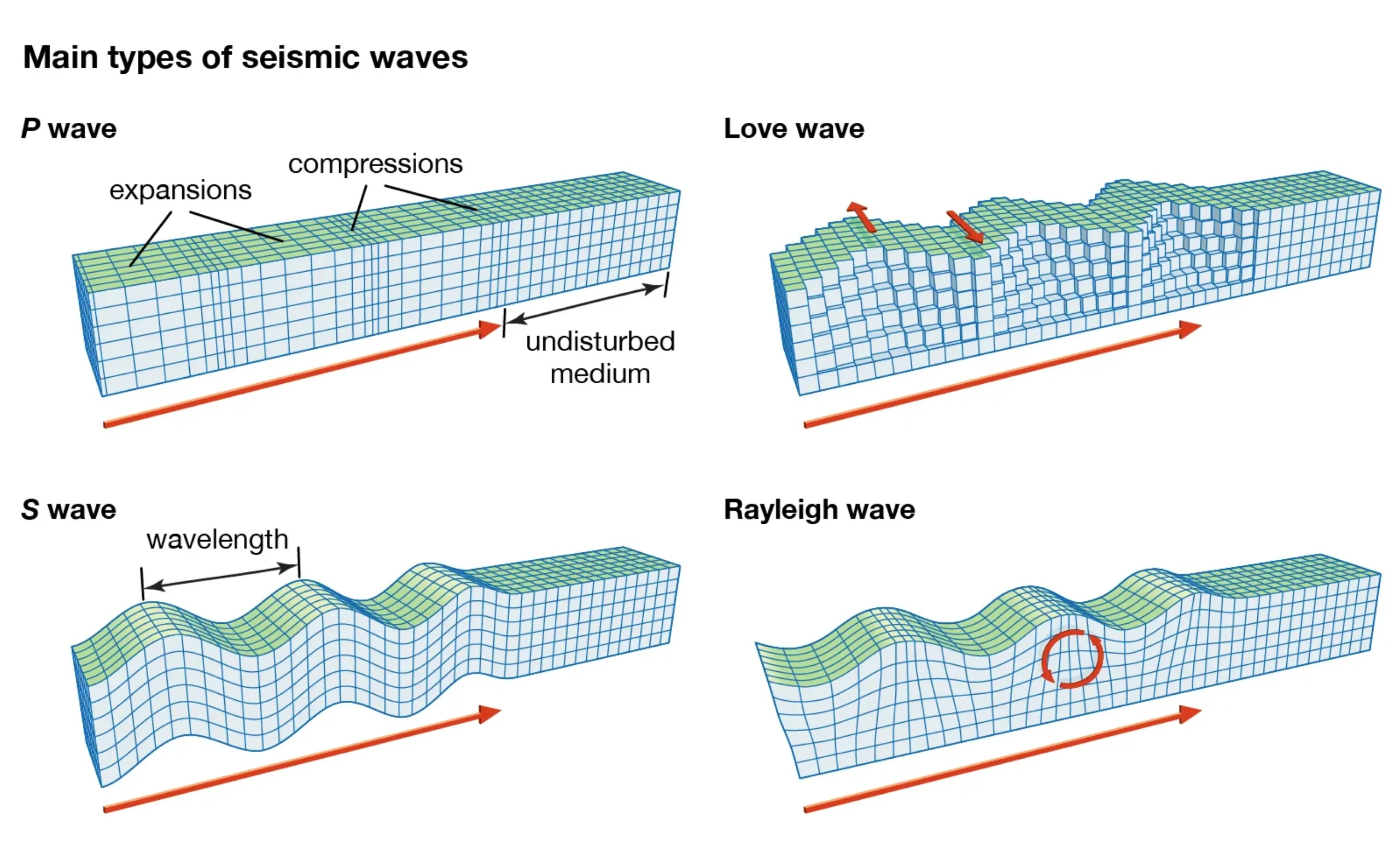
At Fluxiss , a US-based engineering company working across New York, Los Angeles, London, Manchester, Dubai, and Abu Dhabi, we don’t just study earthquake waves in geology textbooks. We design buildings that survive them.
So let’s break this down clearly, simply, and practically.
The 3 Types of Seismic Waves Explained (Simple and Clear)
Seismic waves are of three kinds:
- Primary Waves (P-Waves)
- Secondary Waves (S-Waves)
- Surface Waves (Love and Rayleigh Waves)
Two categories of them include:
- Body Waves – pass internally through the earth.
- Surface Waves – move over the surface of the earth.
This is the usual classification used in the field of earthquake engineering and geology.
The First Signal of an Earthquake: Primary Waves (P-Waves).
Also Called: Compressional Waves
Category: Body Waves
Motion Type: Compressional and longitudinal motion
The fastest seismic waves are the p-waves. Their arrival at seismic stations is first.
As soon as we saw them we thought of rolling a Slinky up and down. This is the mechanism of compressional motion . The particles of the ground travel in the same direction as the wave is moving.
The important properties of the P Wave.
- Velocity: ~6–7 km/s in crust (varies by density)
- Travel through: solids, liquids, and gases
- Lowest destructive energy among earthquake waves
Engineering Perspective at Fluxiss
In the US, especially in California and Washington, early warning systems rely on P-waves. Since they arrive first, automated systems can:
- Stop high-speed trains
- Shut down gas lines
- Pause industrial processes
At Fluxiss, when we design infrastructure in Los Angeles or San Francisco, we consider seismic wave propagation in Earth and how early P-wave detection integrates with smart building systems.
P-waves are not the most dangerous, but they are critical for response systems.
Secondary Waves (S-Waves): Where Structural Risk Begins
Also Called: Shear Waves or Transverse Waves
Category: Body Waves
Motion Type: Shear motion (perpendicular movement)
Now this is where things become serious.
S-waves move the ground up and down or side to side. Unlike P-waves, their motion is perpendicular to the direction of travel. This creates shear forces .
They cannot travel through liquids. This is how scientists discovered Earth’s liquid outer core.
Key Characteristics of S Wave
- Velocity: ~3–4 km/s
- Travel through: solids only
- Higher destructive energy than P-waves
What We See in Engineering Practice
In structural design meetings, S-waves are where we focus heavily. Why? Because shear motion creates base shear forces . These forces:
- Stress columns
- Crack foundations
- Cause structural drift
- Lead to soft-story collapse
In high-seismicity regions like California, the ASCE 7-22 code requires advanced seismic design of structures to resist S-wave effects.
At Fluxiss, we use:
- Nonlinear Response History Analysis (NRHA)
- Buckling Restrained Braces
- Base isolation systems
These are not trends. They are required because S-waves create real structural response under seismic load.
Surface Waves: The Most Destructive Earthquake Waves
When people ask which type of earthquake wave causes maximum damage, we say surface waves.
Category: Surface Waves
Speed: ~2–3 km/s
Energy: Highest amplitude and longest duration
Surface waves stay near Earth’s crust. That means buildings absorb more of their energy. They are divided into:
Love Waves: Horizontal Side-to-Side Motion
Love waves create a horizontal zig-zag motion. They are dangerous for:
- Foundations
- Bridges
- Underground piping systems
In urban areas like New York City, London, and Manchester, where soil conditions vary, Love waves amplify damage through soil-structure interaction.
Rayleigh Waves: Rolling Ground Motion
Rayleigh waves move like ocean waves.
They create:
- Vertical displacement
- Horizontal displacement
- Rolling ground motion
This rolling effect damages:
- Tall buildings
- High-rise towers
- Pipelines
- Metro systems
The impact of seismic waves on piping systems becomes critical in oil and gas projects we handle in Houston and Dubai.
Body Waves vs Surface Waves Comparison (What Matters for Engineers)
Feature
Body Waves (P & S)
Surface Waves
Travel Path
Through Earth interior
Along surface
Speed
Faster
Slower
Damage Level
Moderate to high
Extreme
Motion
Compressional & shear motion
Rolling & horizontal
In real projects, surface waves cause the most visible collapse. But S-waves often initiate structural failure.
Understanding the difference between P, S, and surface waves helps us design smarter.
How Seismic Waves and Their Characteristics Shape Modern Codes (USA vs UK)
Physics is universal. But engineering standards vary.
USA – ASCE 7-22 & 2026 Updates
Focus areas:
- Seismic Design Categories (SDC)
- Risk Categories
- Nonlinear analysis for critical structures
In states like California, Alaska, and Washington, seismic analysis is mandatory even for mid-rise buildings.
UK – Eurocode 8 (BS EN 1998)
The UK traditionally had lower seismic risk. But updated 2026 Eurocode provisions emphasize:
- Seismic Action assessment
- Limit State Design
- Critical infrastructure protection ( HS2 rail , nuclear plants)
At Fluxiss, when we work in London or Manchester, soil-structure interaction becomes a major design variable.
Earthquake Waves and Their Effects on Structures
Let’s understand this simply. When an earthquake hits:
- P-wave arrives (warning stage)
- S-wave creates shear stress
- Surface waves amplify ground motion
The structure responds based on:
- Natural frequency
- Damping ratio
- Mass distribution
- Foundation type
This is called structural response under seismic load .
We simulate earthquake wave energy dissipation using advanced modeling tools before construction even begins.
Why Understanding Types of Earthquake Waves in Geology Matters for Real Buildings
Many people think this is academic theory. It’s not. When we design: Hospitals, Airports, High-rise towers, Industrial piping systems, We analyze:
- Wave velocity in Earth’s layers
- Local soil amplification
- Ground motion during earthquakes
- Seismic wave propagation in Earth
If we ignore even one of these, the risk multiplies.
Every region has different seismic profiles. But the three types of seismic waves explained remain constant everywhere.
We design based on:
- Local seismic hazard maps
- Soil reports
- Performance-based seismic analysis
- Global building standards
Conclusion: Designing for a Moving World
We can not prevent the movement of the Earth at the end of the day. The energy is coming whether it is the high-speed P-wave or the destructive roll of a Rayleigh wave. And that is what our work and the work of all of us in Fluxiss is to ensure that when such waves strike Chicago, Paris, or Riyadh, your office and home will remain in their places.
The knowledge of the three types of seismic waves explained above is not only the study of science, but it is the plan for a strong future.
Frequently Asked Questions
There are two types in geology, namely, Body waves and Surface waves. The body waves consist of the Primary (P) and Secondary (S) waves that go through the interior of the Earth. Surface waves which comprise the Love waves and the Rayleigh waves traverse along the crust and cause the most visible surface destruction.
Fluxiss Editorial is part of the Fluxiss engineering team, delivering seismic scopes across the USA, UK, UAE and Europe.



Let's Build Something Great Together.
Partner with Fluxiss for engineering that holds up - under pressure, under load, under scrutiny.