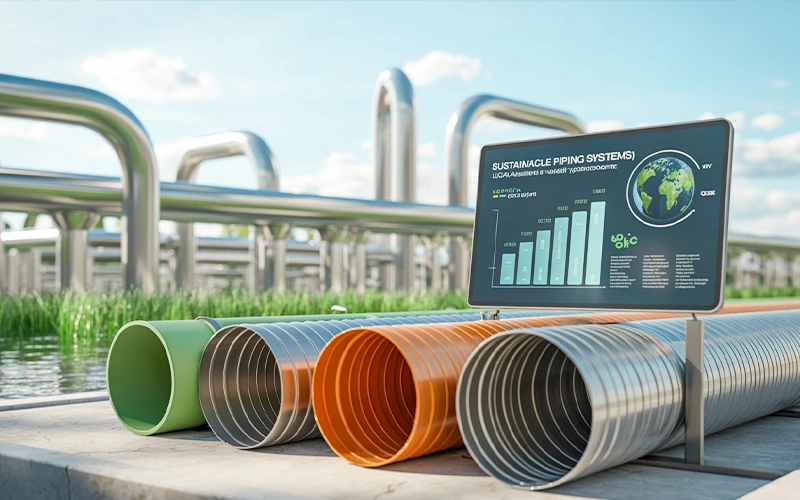
And to get a better understanding of what LCA actually entails in terms of piping systems, why it is important to engineering firms in the USA, and how Fluxiss has used it in actual projects, let us first define LCA.
What is Life Cycle Assessment Piping Systems?
Life cycle assessment (LCA) for piping systems is a method to measure the total environmental impact of pipes from production to disposal. This includes:
- Raw material extraction
- Manufacturing process
- Transportation and installation
- Operation and maintenance
- End-of-life disposal or recycling
LCA looks at the whole picture rather than merely looking at the initial costs. This assists the firms in the USA to make LCA pipe materials comparison (e.g., PVC vs HDPE vs steel) using precise data on performance, durability and sustainability.
Learn more about how we apply this and other Fluxiss Services .
LCA Pipe Materials Comparison (PVC vs HDPE vs Steel)
When clients enquire about the better pipe material, there is no universal solution. LCA assists in responding to this on a factual basis.
- PVC pipes : They are lightweight, have low energy consumption in transportation, but show less durability when subjected to extreme heat.
- HDPE pipes : It is highly resistant to chemicals, long-lasting, but it needs more energy is required to manufacture.
- Steel pipes : They are powerful and recyclable; however, during production, they have a heavy carbon footprint.
At Fluxiss, we run LCA pipe materials comparison models to show the trade-offs clearly. This allows the project managers to make decisions based on cost, performance and sustainability.
Environmental Impact of Pipe Materials
The environmental impact of pipe materials doesn’t stop at the factory gate. For example:
- PVC generates byproducts that are chlorine-based.
- HDPE is more energy-consuming and less leaky.
- Steel has a high global warming potential (GWP ), yet it can be recycled over and over.
This is the reason why ISO 14040 pipe life cycle standards are vital. The Fluxiss adheres to these frameworks to assess the material selections in the US-based projects.
Embodied Carbon in Piping Systems
Embodied carbon in piping systems is a term used to refer to the total CO2 emissions in manufacturing, transportation, and installation.
- Embodied carbon in plastic pipes is usually lower than steel.
- Recycled steel will eliminate a lot of emissions.
- Reuse and recycling pipes- the circular economy in pipe manufacturing is another way of reducing carbon.
Fluxiss incorporates carbon tracking in the design processes to assist clients to achieve corporate sustainability targets.
Life Cycle Cost of Piping Systems
It is not only about carbon, but it is also about money. The life cycle cost of piping systems is comprised of:
- Material and installation cost
- Operation and energy use
- Maintenance and repairs
- Replacement or disposal
Clients are often surprised when LCA reveals that a slightly higher upfront cost may result in much lower total cost over 30–50 years.
Sustainable Piping Design USA: Fluxiss Approach
Our firm, focuses on sustainable piping design in the USA by:
- Using EPD for plastic pipe systems as verified data sources.
- Evaluating embodied energy of piping systems before selection.
- Taking into consideration the life span of metal vs plastic pipes in real-world performance.
- Development on the principles of green infrastructure and piping , so that systems are designed to fit into the natural water cycles.
If you want to explore sustainable design for your project, reach out at Fluxiss Contact .
Carbon Footprint of Water Pipe Infrastructure
The carbon footprint of water pipe infrastructure is now a key metric in US engineering projects. This footprint covers:
- Energy used in pumping water through pipes
- Leakage rates and water loss
- Material replacement over decades
Fluxiss applies monitoring tools to reduce both operational energy and leakage, lowering long-term footprints.
Green Infrastructure and Piping
Green infrastructure and piping involve developing water systems that are compatible with the ecosystems. Examples include:
- Permeable piping, which recharges groundwater.
- Integration with rainwater harvesting
- Reduced surface runoff management
The strategy is becoming popular in aUS cities, where the legislation is driving towards climate-sensitive infrastructure.
Circular Economy in Pipe Manufacturing
Instead of a “take, make, waste” model, the circular economy in pipe manufacturing focuses on:
- Recycling end-of-life pipes
- Designing pipes for disassembly
- Using secondary raw materials
Fluxiss partners with suppliers who follow these principles, ensuring clients get environmentally and economically efficient systems.
ISO 14040 Pipe Life Cycle: The Standard to Follow
ISO 14040 outlines the life cycle assessment system on a global scale. In the case of piping systems, it guarantees:
- Consistent data comparison
- Standardized assessment strategies.
- Transparent reporting in the form of environmental product declarations (EPDs).
At Fluxiss, we align our projects to the ISO standards to deliver credible sustainability reporting to the clients.
Conclusion: Why Fluxiss Focuses on Life Cycle Assessment
Life cycle assessment piping systems is not optional anymore; they are a must in current engineering. By combining LCA with smart design, we help clients:
- Reduce embodied carbon and embodied energy
- Lower life cycle costs
- Achieve compliance with ISO 14040 and environmental regulations
- Improve the durability and performance of piping infrastructure
At Fluxiss, sustainability isn’t an add-on. It’s part of how we design every system.
Explore our full range of engineering services or talk to us directly here .
Frequently Asked Questions
It is one way of measuring the environmental and cost effects of pipes between production and disposal. It assists in comparing materials such as PVC, HDPE, and steel.
Fluxiss Editorial is part of the Fluxiss engineering team, delivering pipe stress scopes across the USA, UK, UAE and Europe.


Let's Build Something Great Together.
Partner with Fluxiss for engineering that holds up - under pressure, under load, under scrutiny.