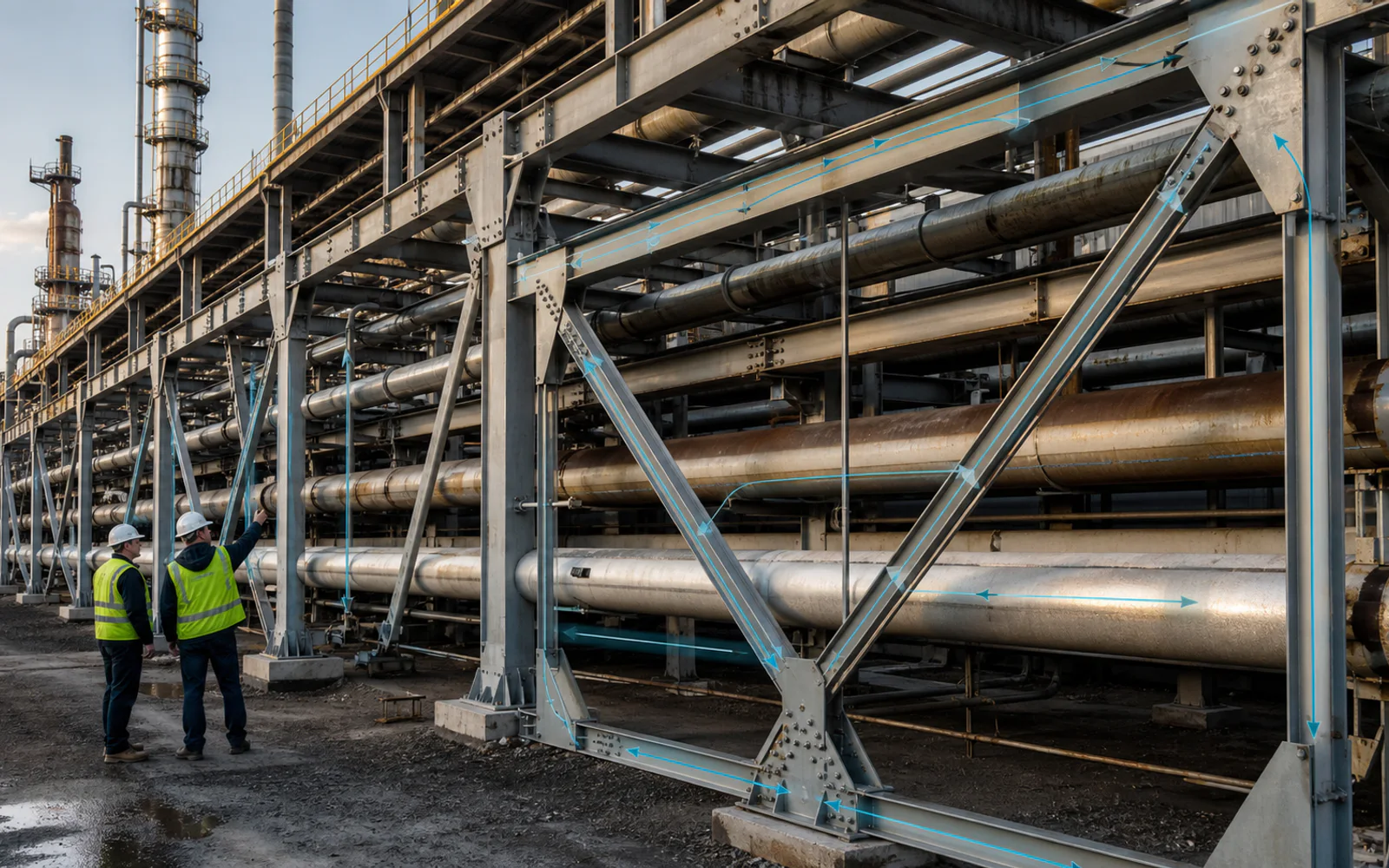
Most operating plants in seismic regions were designed to codes that predate current ASCE 7 provisions. The racks still stand, the lines still run, but a modern seismic evaluation routinely flags deficiencies - base shears that exceed the original design, drift ratios that exceed current limits, brace slenderness that no longer qualifies as a seismic-force-resisting system. Replacing the rack is rarely an option; retrofitting it, in a live plant, is the work.
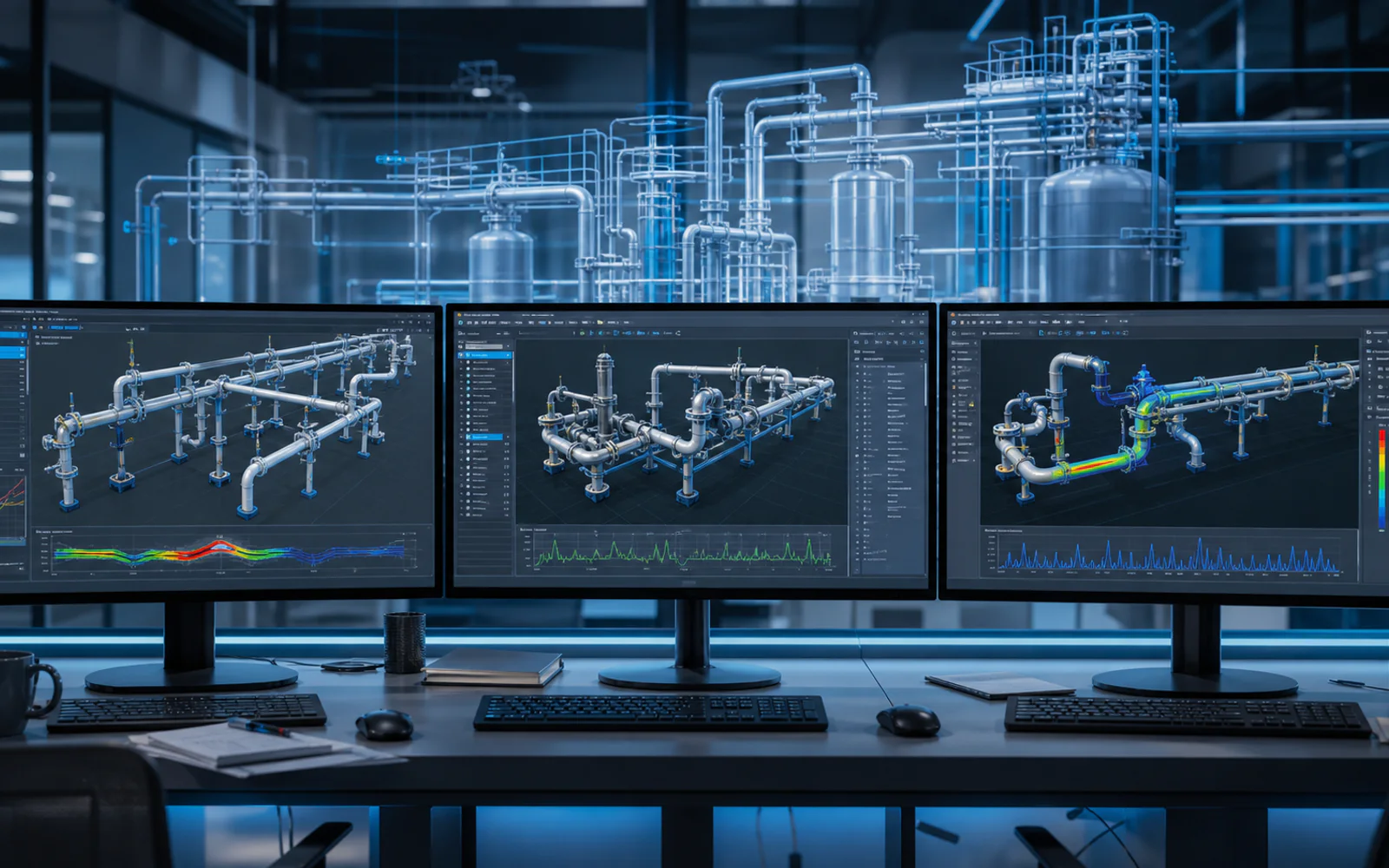
Our approach starts with an as-built model. We survey the rack - member sizes, connections, base details, foundation caps - and build a STAAD.Pro model that reflects what is actually in the ground, not what was on the original drawings. The discrepancy between the two is often the first finding: braces omitted during a previous modification, base plates grouted differently from design, accidental restraints from adjacent structures.
“A practical approach to evaluating and strengthening existing pipe racks against current seismic codes - without replacing the structure or shutting down the line.”
We then run an equivalent lateral force (ELF) analysis to ASCE 7 against the current seismic hazard for the site. Where the ELF is inapplicable - torsional irregularities, height-to-weight ratios, or racks with significant mass irregularity - we run a response-spectrum analysis. The output is a demand-to-capacity ratio for every member and connection, with failures categorised as strength, stability or drift-driven.
Retrofitting is then prioritised. Strength-driven failures in the seismic-force-resisting system are addressed first, typically by adding or upgrading braces, stiffening base plates, or introducing collector elements to close load-path gaps. Drift-driven failures are addressed by stiffening the rack - usually by adding bracing in one or two bays - which reduces drift and often resolves secondary failures as a side effect. Stability-driven failures, where members are too slender to qualify, are resolved by section upgrades or by re-categorising the system.
“The goal is not to bring a 1970s rack up to a 2025 new-build standard,” said M Bilal, Principal Analyst. “It is to close the load path, contain the drift, and demonstrate to the authority having jurisdiction that the rack has a defensible seismic capacity under current hazard - all while the line above it stays running.”
Deliverables are a retrofit design package - strengthening drawings, connection details, foundation checks - plus a seismic evaluation report that documents the as-built model, the demand-to-capacity ratios, and the post-retrofit capacity. Where the authority requires it, the package supports a stamped seismic certification through a licensed PE in the project jurisdiction.
M Bilal is part of the Fluxiss engineering team, delivering seismic scopes across the USA, UK, UAE and Europe.


Let's Build Something Great Together.
Partner with Fluxiss for engineering that holds up - under pressure, under load, under scrutiny.