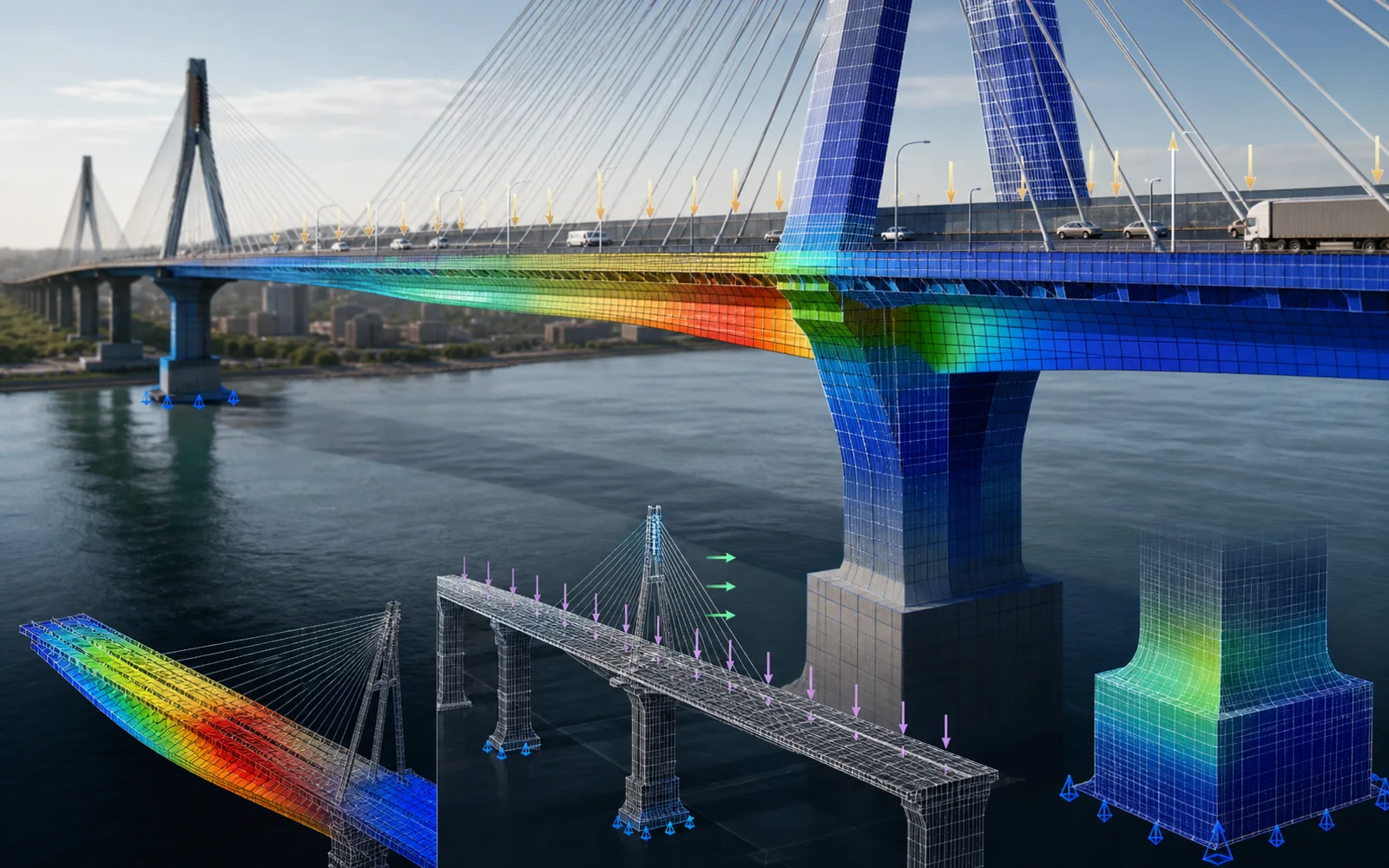
Back in the day, firms relied on ultra-conservative, oversized manual calculations. But today, Fluxiss , we do things differently. We use finite element structural analysis to build mathematical models of these giants and push them to their absolute physical limits long before construction crews ever pour a single cubic meter of concrete on site.
If you have ever wondered exactly how modern megastructures in New York, Birmingham, Chicago, or Dubai stay completely rigid during heavy winds, the simple answer is FEA in structural engineering . Let’s break down exactly how this mathematical wizardry works based on my years of managing high-level civil infrastructure projects across the US, UK, Europe, and the UAE.
The Naked Truth Behind Finite Element Structural Analysis
Let’s strip away the overly dense academic textbook jargon for a second. Imagine you have a highly complex, irregular concrete floor slab for a new corporate skyscraper project in Los Angeles or Frankfurt. Trying to calculate how that massive, asymmetric shape responds to loads using old-school manual math formulas is a complete nightmare. You just cannot do it accurately by hand.
What we do instead is use specialized structural simulation software to digitally chop that massive slab into thousands of tiny, simple geometric shapes-like little triangles or squares. These individual pieces are what we call “finite elements.” Because each individual element is small and simple, the software can easily run exact equations on every single block to perform a clean structural analysis using FEA .
The software then glues the whole puzzle back together at the connecting corners, which we call nodes. This gives me a complete, ultra-clear digital map of how the entire structure breathes, bends, and resists stress under extreme field pressures.
Why Our Engineers Deliberately Try to Break Digital Buildings
Predicting the Unpredictable: Advanced FEA Load Analysis
When we design a high-rise residential tower in Houston or a commercial complex in Manchester, gravity is only the beginning of our worries. We have to map out a massive array of variable forces, including howling winds, heavy snow accumulations, and sudden seismic ground movements. This is where high-fidelity FEA load analysis becomes absolutely critical for survival.
Using our internal simulation pipelines at Fluxiss, we can load a digital twin of a building with multi-directional environmental forces simultaneously. The software runs thousands of matrix calculations ([K]{u}={F}) to determine exactly how those forces travel down from the roof, through the intermediate floor slabs, into the columns, and deep down to the foundation piles. This systematic load distribution tracking allows us to find dangerous hidden structural paths that traditional, simplified static routines completely miss.
Hunting Down Stress Concentrations Before They Cost Millions
Have you ever seen a tiny crack in a pane of glass suddenly tear across the entire window? That happens because of localized stress buildup. In large infrastructure projects, a poorly detailed connection can trigger a catastrophic failure. By executing a meticulous stress analysis in structures , we can see exactly where internal forces build up to dangerous levels.
The simulation software generates highly detailed color-coded heatmaps. Bright red zones indicate areas experiencing intense stress, while cool blue zones indicate parts of the structure that are completely relaxed. If we notice a beam-to-column joint glowing bright red under standard load combinations, it tells us we need to immediately thicken the steel gusset plates or change the weld configuration. This precise troubleshooting guarantees absolute structural integrity before any physical materials are ever ordered.
From High-Rises to Highway Crossings: Real Civil Engineering FEA Applications
At Fluxiss, our team works across major global design hubs-delivering engineering blueprints from New York and Los Angeles to London, Manchester, and Dubai. The structural demands differ radically by region, but our core toolset remains exactly the same.
Optimizing Complex FEA for Buildings and Bridges
When it comes to complex infrastructure, bridges are entirely different beasts compared to office buildings. A bridge has to withstand massive, constantly moving vehicular live loads that create continuous cycles of structural fatigue. Through specialized FEA for buildings and bridges , we can simulate heavy freight trucks driving across a span at varying speeds.
This allows us to track dynamic shear shifts and localized deformations in real time. Whether we are checking long-span steel trusses in Birmingham or calculating the wind resistance of a glass-decked suspension bridge in the UAE, these advanced civil engineering FEA applications allow us to optimize material distribution. This means we can put high-strength steel exactly where it is needed and strip it out where it is dead weight, saving our clients millions in raw construction costs.
Eliminating the Guesswork in Complex Beam Analysis
Standard textbook formulas work perfectly fine if you are dealing with a perfectly straight, uniform steel beam. But modern architecture is rarely that simple. We routinely design custom tapered plate girders, beams with large cellular openings for utility ducts, and curved architectural sweeps.
By using beam analysis models driven by finite element code, we can easily simulate complex buckling behaviors, lateral-torsional twisting, and web crippling. This ensures that every single floor support beam meets both US AISC standards and UK Eurocode structural compliance margins without defaulting to oversized, heavy steel members.
Stopping Destructive Resonance with Vibration Analysis
It is completely possible for a building to be extremely robust in its ability to support its own weight, yet fail due to excessive vibration. Hoisting winds from high altitudes or a marching crowd can produce severe resonance of a building whose natural frequency closely resembles their rhythm. This may cause the occupants room to become seasick or over time, to literally destroy the structure.
We perform in-depth vibration analysis of all thin floor slabs and long span pedestrian bridges designed. The software computes exact modes and natural frequencies of such systems. When the model indicates that the layout will bounce too much when people are walking across the floor, we take steps to reinforce the layout to a considerable extent in advance, or plan to install tuned mass dampers.
The Fluxiss Edge: Making Construction Engineering Safer and Smarter
Our work at Fluxiss does not stop once the design drawings are stamped. We bring finite element analysis directly into the active construction engineering phase to keep field operations running smoothly and safely.
Buildings do not just appear instantly; they are built piece by piece, story by story. A high-rise concrete core in Dubai or a massive steel framework in London is highly vulnerable during its mid-construction phase when it is only half-built and unbraced. We use staged construction simulation to model the exact sequence of assembly. We check temporary shoring systems, calculate crane support loads, and make sure that newly poured concrete can safely handle erection loads before the next floor is stacked above it. This eliminates surprises on site, keeping field crews safe and avoiding expensive project delays.
Let’s Engineer Something Insanely Safe Together
At the end of the day, finite element structural analysis is not just about cool looking 3D heatmaps or satisfying software animations. It is about building a world where you can walk into a high-rise office building, cross a massive river span, or live in a coastal apartment complex without ever having to worry about the engineering holding it together. It gives us the empirical proof we need to push architectural boundaries safely.
If you are planning a complex structural project in New York, London, Chicago, Dubai, or anywhere else globally, our engineering team at Fluxiss is ready to optimize your designs for absolute safety, cost efficiency, and code compliance.
Frequently Asked Questions
Running destructive tests in the real world are extremely costly, and impractical for skyscrapers or large highway bridges. FEA is a fast, affordable virtual solution to generate this kind of testing over thousands of extreme environmental load scenarios with our engineering teams all in a computer boosted project approval timelines.
Fluxiss Editorial is part of the Fluxiss engineering team, delivering structural scopes across the USA, UK, UAE and Europe.



Let's Build Something Great Together.
Partner with Fluxiss for engineering that holds up - under pressure, under load, under scrutiny.