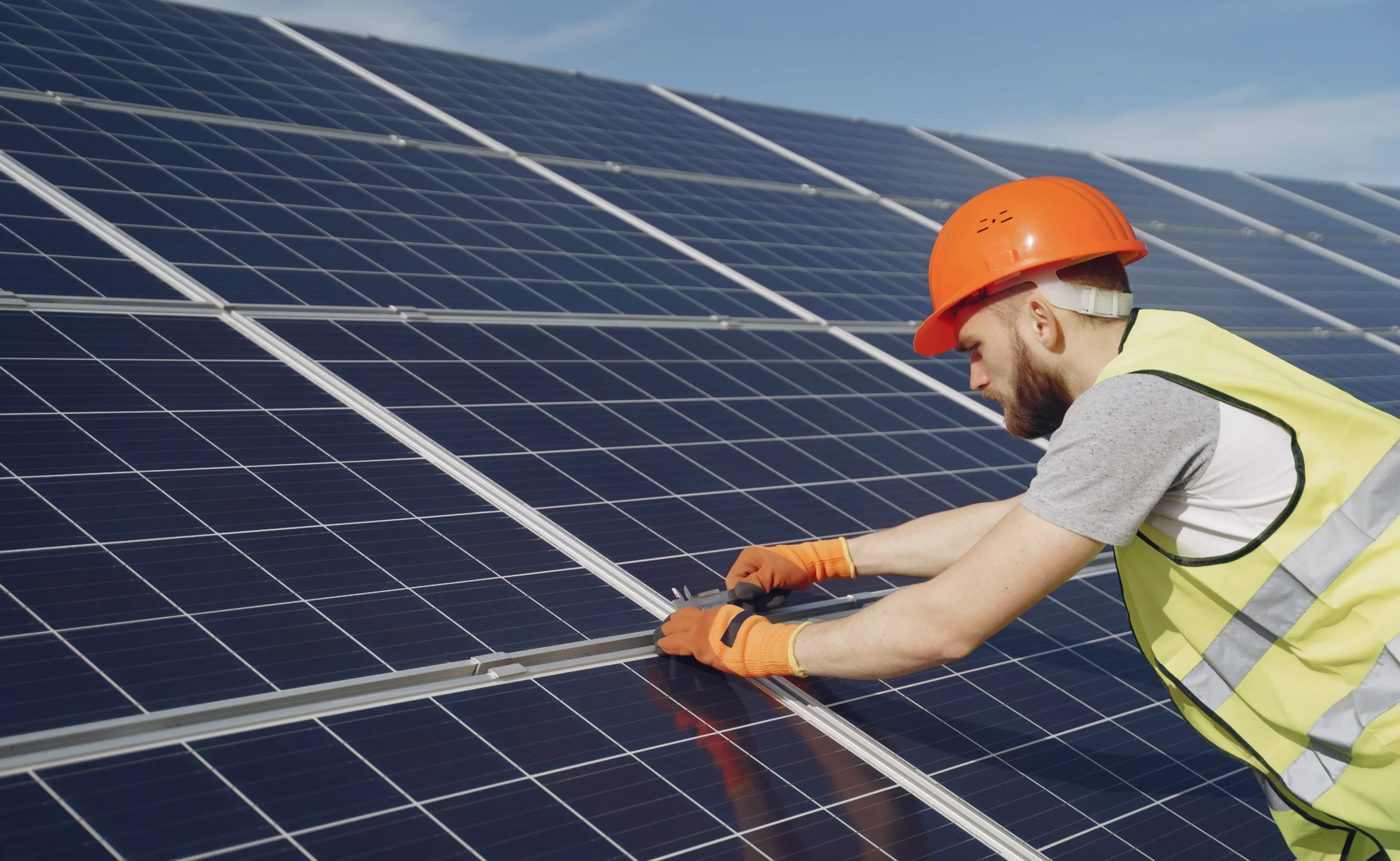
Whether you are sitting in a high-rise in New York , a warehouse in London , or a villa in Dubai , the tech on your roof is doing the same heavy lifting. We want to walk you through the working principle of solar cell technology and why it’s the backbone of renewable power generation today.
The “Secret Sauce”: Photovoltaic Effect Explained
We remember reading our first technical manual and seeing the term “ photovoltaic effect explained ” in a way that sounded like a robot wrote it. Let’s give it to you straight.
The photovoltaic effect is what happens when sunlight hits a specific material (usually silicon) and kicks electrons into high gear. We’ve observed this in our testing labs at Fluxiss; it’s all about the “photo” (light) creating “voltaic” (voltage). Without this effect, your panels are just expensive roof tiles.
Inside the Layers: Components of a Solar PV Cell
When we take a panel apart, we don’t just see one thing. We see a sandwich of high-tech materials. If you’re in Houston or Manchester , your panels are likely built with these exact components of a solar PV cell :
- Tempered Glass: This is the shield. It protects the fragile “guts” from hail and debris.
- Anti-Reflective Coating: You know how some panels look dark blue or black? That’s to make sure sunlight absorption process is high and reflection is low.
- The Silicon Wafers: This is where the silicon solar cell working mechanism happens.
- Metal Grid: These thin lines collect the moving electrons.
- Backsheet & Frame: Keeps everything rigid and moisture-free.
Step-by-Step: How Photovoltaic Cell Works
We have to explain this to clients from Chicago to Abu Dhabi , and we found that breaking it down into a step-by-step flow is the only way it sticks.
Step 1: Catching the Rays
The sunlight absorption process begins the second those photons hit the top layer of the cell. We use semiconductor materials -mostly silicon-because they are “picky” about how they hold onto electrons.
Step 2: The Electron Breakup
When a photon hits an atom in the silicon, it causes electron-hole pair generation . Think of it as a breakup; the electron gets enough energy to leave its “home” (the atom), leaving a “hole” behind.
Step 3: The P-N Junction Traffic Cop
This is the part we find most fascinating. Every cell has a p-n junction . This is an internal barrier that acts like a one-way street. It forces the loose electrons to move in one direction and the holes in the other. If we didn’t have this, the electrons would just wander around and never create a current.
Step 4: DC Electricity Generation in Solar Panels
Once those electrons are pushed through the p-n junction , they flow into the metal contact grid. This flow is what we call DC electricity generation in solar panels . It’s raw, direct current power ready to move.
From Roof to Socket: Inverter Conversion DC to AC
One thing people forget is that your toaster can’t run on DC power. While the solar photovoltaic cell creates DC, your home in Los Angeles or London runs on AC.
This is where the inverter conversion DC to AC happens. The inverter takes that raw flow and “shakes” it back and forth 50 or 60 times a second so your appliances can actually use it.
The Different Types of Photovoltaic Cells I’ve Researched
We have found out that not every cell is equal at Fluxiss. In such cities as San Francisco or Birmingham you will find either of the following in accordance with your budget and space:
- Monocrystalline: These are the professional versions. They have high solar energy conversion efficiency and they appear sleek since they are prepared in a single crystal.
- Polycrystalline: It is a little older, bluish and slightly less effective, but good when you have much space and when a smaller budget is involved.
- Thin-Film: Thin-Film: These are flexible. They are applied on curved roofs in Dubai where the traditional panels can not fit.
Why Solar Energy Conversion Efficiency Matters
It is argued that people have panels that do not turn all of the sunlight into power, nor do they convert more than 20%. Although that is low, take the following into consideration; in the 1950s we were blessed with 4%. We are always considering ways of pushing those limits at Fluxiss with semiconductor materials . Tandem cells (stacking materials) which are pushing toward 30 percent in the lab are being seen in 2026.
Is This Right for You?
After studying the solar panel internal structure for years, I’m convinced that renewable power generation is the only way forward for our global infrastructure. Whether Fluxiss is helping a firm in Leeds or a factory in California , the goal is the same: clean, predictable power.
It’s a big investment. But knowing how solar panels generate electricity takes the mystery out of it and helps you make a choice based on engineering, not just marketing.
Work With Fluxiss
Are you ready to transition to high-efficiency solar? At Fluxiss , we provide world-class engineering consulting and solar implementation across the USA, UK, Europe, and UAE . Let our team handle the technical details while you enjoy the savings.
Click Here to Get Your Free Engineering Consultation with Fluxiss
Frequently Asked Questions
The principle of operation of a solar photovoltaic cell is basically to use sunlight to remove electrons in silicon atoms. A p-n junction inside the body is now a one-way street, and compels these electrons to travel in a circuit, and is the one that generates the DC electricity in the solar panels on which we draw our power.
Fluxiss Editorial is part of the Fluxiss engineering team, delivering solar & energy scopes across the USA, UK, UAE and Europe.



Let's Build Something Great Together.
Partner with Fluxiss for engineering that holds up - under pressure, under load, under scrutiny.