The “Internal” Fast Track: Body Waves vs Surface Waves
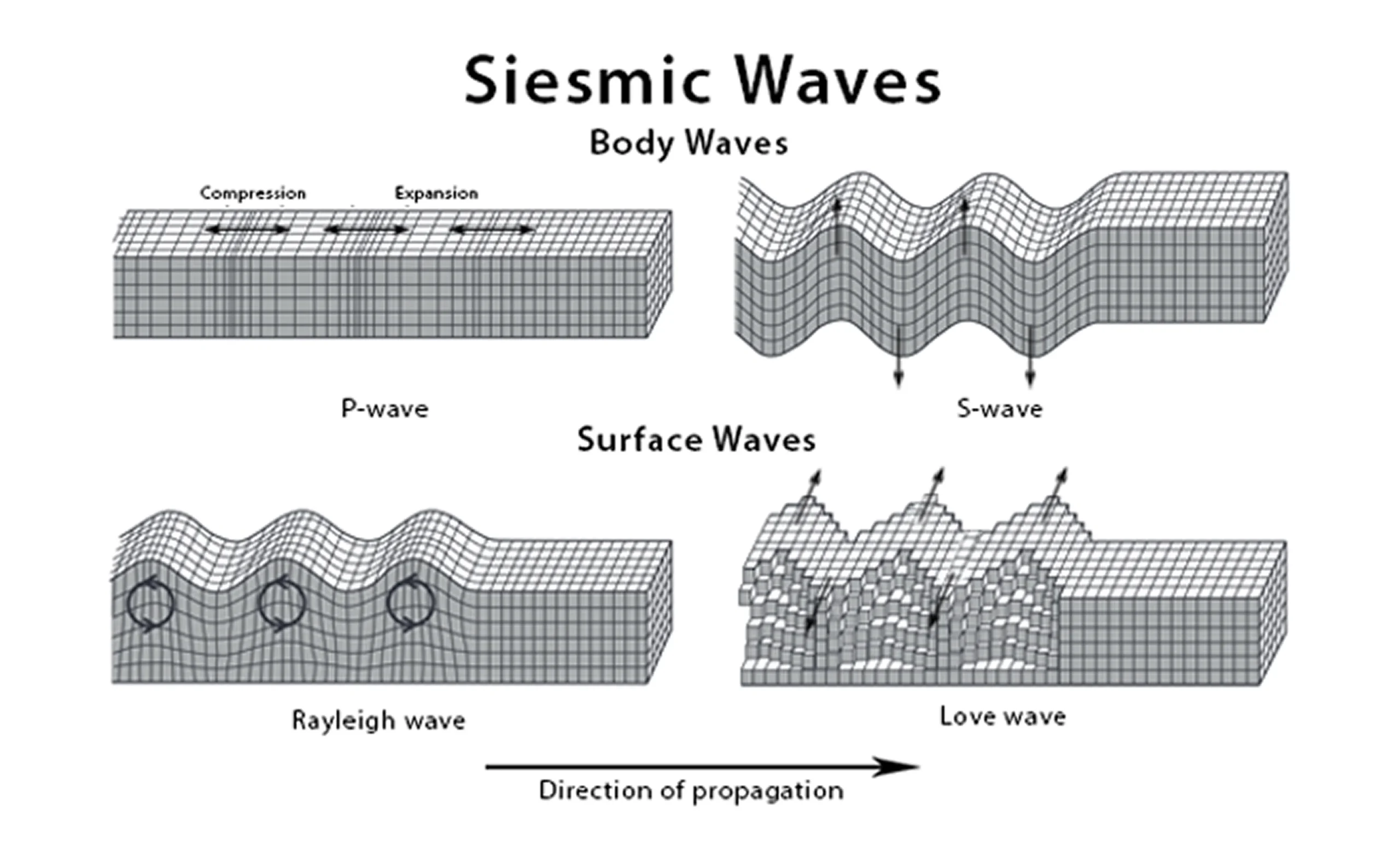
When an earthquake hits, the energy doesn’t just appear at your doorstep. It travels. The first things to arrive are the body waves . Think of these as the “scouts.” They travel through the interior of the Earth, taking the shortest route possible.
We have observed in our research and in the field how the body waves vs surface waves work on a seismogram. Body waves are rapid and of high frequency. They inform the building, “Something is coming. However, since they go far under the crust and mantle of the Earth, before reaching the surface, they weakened considerably.
P-Waves and S-Waves Explained: The Push and the Shake
In the category of body waves, there are two key participants. You have most likely heard of compressional and shear waves and this is nothing more than fancy language to say P and S waves.
- P-Waves (Primary): These are the fastest. They move like a slinky-pushing and pulling the ground. If you’re standing in a building in San Francisco, you might feel a sudden vertical “thump.” That’s the P-wave.
- S-Waves (Secondary): These arrive a bit later and move side-to-side. Since most buildings are designed for gravity (up and down), this lateral shearing is where the real stress starts.
The Surface Destroyers: Why Rayleigh and Love Waves Matter
If body waves are the scouts, surface waves are the heavy artillery. They only travel along the ground surface, and they are much slower, but they carry a lot of energy. This is where subsurface vs surface motion becomes a critical design factor at Fluxiss.
Rayleigh and Love Waves Differences You Should Know
We’ve studied enough disaster footage to know that what we call “ ground rolling ” is usually Rayleigh waves . They move the ground in an elliptical motion-up, back, down, and forward. It’s like being on a boat in a choppy sea.
Love waves , on the other hand, are strictly horizontal. They shift the ground from side to side at the surface. In our projects across the UK and UAE, we’ve found that Love waves are often the culprits behind foundation failures because they “wiggle” the building right off its footprint.
2026 Engineering Standards: How Fluxiss Protects Your Assets
As of 2026, the ASCE 7-22 and 7-28 updates in the USA and the Second Generation Eurocode 8 in Europe have changed the game. We don’t just look at “peak ground acceleration” anymore. We model the seismic vibration impact on structures using multi-period design spectra.
Seismic Response of Piping Systems
When we design for the seismic response of piping systems , we have to account for both wave types.
- Body waves cause axial strain (stretching the pipe).
- Surface waves cause bending and curvature.
If you don’t account for the structural response to Rayleigh waves , your pipeline in a city like Los Angeles or London will likely buckle during the “rolling” phase of the quake.
Soil–Structure Interaction Modeling (SSI)
One thing we’ve learned from the veteran engineers here at Fluxiss is that the soil is a filter. Wave energy dissipation near surface depends entirely on whether you’re on rock or soft clay. In 2026, our soil–structure interaction modeling allows us to predict how surface waves will be amplified in “soft” cities like Dubai or New Orleans.
The Ultimate Seismic Wave Motion Comparison
Feature
Body Waves (P & S)
Surface Waves (Rayleigh & Love)
Travel Path
Deep through Earth’s interior
Along the crust/surface
Speed
Very Fast (Scout waves)
Slower (Destructive waves)
Frequency
High Frequency
Low Frequency
Engineering Threat
Brittle fracture, sudden jolts
Resonance, foundation shear, rolling
Conclusion: Riding the Waves of Resilience
Surface and body seismic waves are different at the day’s end not only because it has a physics problem–but it is a safety mission. We consider each type of earthquake wave in engineering and geology a challenge at Fluxiss . We are not only building to code but we are building to the fact of the ground we are on. It can be the high-speed snap of a P-wave or the long-period roll of a Rayleigh wave but we are not supposed to struggle with the Earth but dance along with it.
Frequently Asked Questions
While all waves carry risk, surface waves (specifically Love and Rayleigh waves) are the most destructive. Their large amplitude and slow decay mean they hit buildings with more energy over a longer duration. Fluxiss specializes in seismic design considerations that mitigate these specific low-frequency surface motions.
Fluxiss Editorial is part of the Fluxiss engineering team, delivering seismic scopes across the USA, UK, UAE and Europe.



Let's Build Something Great Together.
Partner with Fluxiss for engineering that holds up - under pressure, under load, under scrutiny.