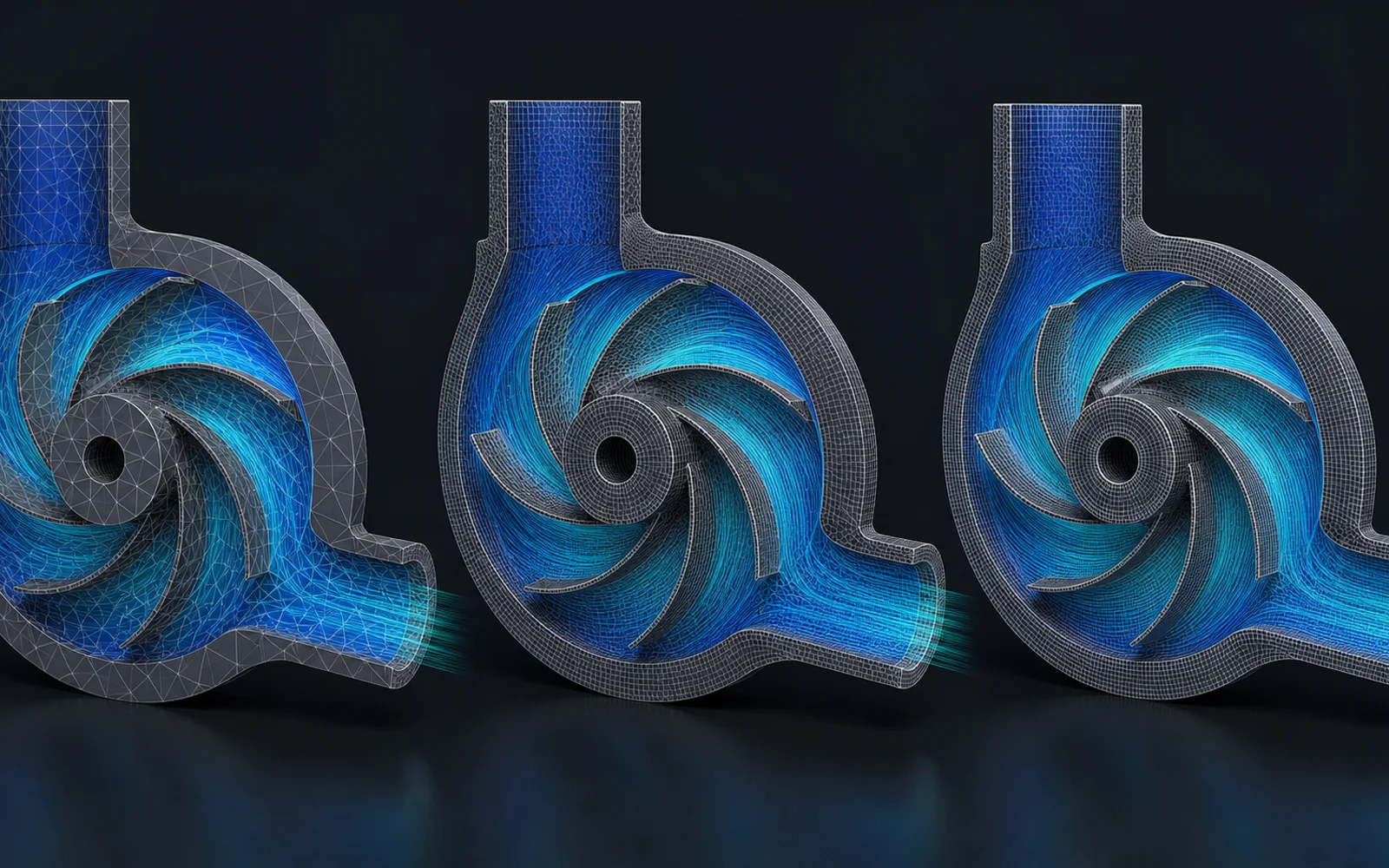
Every CFD report we issue carries a mesh independence study. Not because clients always ask for one - many do not - but because a reported result without one is a claim, not a finding. The discretisation error in a CFD solution can easily exceed the difference between two design options, and the only way to bound that error is to solve the same case on successively finer grids and watch the quantity of interest converge.
The mechanics are straightforward. We start from a baseline mesh sized to resolve the geometry and the expected flow features, then refine - typically by halving the target cell size in the region of interest - and re-run. We track the quantity of interest (a pressure drop, a peak velocity, a mass-flow split, a temperature) across at least three grids, and compute the apparent order of convergence using the Richardson extrapolation or, where the solution is monotonic, a simpler observed-order estimate.
“A documented mesh independence study is the difference between a CFD result and a CFD claim. Here is how we approach it, and the metrics we track.”
What we are looking for is not a single “converged” value. It is a bound: the range across the two finest grids, plus an estimate of the remaining discretisation error. That bound is what we report. If the design decision hinges on a difference smaller than that bound, the CFD cannot resolve it - and the right answer is to either refine further or change the question.
Where studies go wrong is usually in the choice of refinement, not the choice of method. Global refinement is expensive and rarely necessary; local refinement in the region governing the quantity of interest is usually sufficient. But the refinement must be nested - refining the same cells each time, not re-meshing with a different topology - otherwise the comparison is between different discretisations, not different resolutions.
The other common failure is tracking the wrong quantity. A monitor point that is convenient to extract (a downstream mass-averaged pressure, say) is not always the quantity the decision hangs on. Track the decision quantity, not the convenient one - and if the decision quantity is a maximum (a peak wall shear, a hot-spot temperature), report the convergence of that maximum specifically, not a domain average.
Our CFD reports therefore carry the mesh independence study as a short annex: the three meshes, the tracked quantities, the observed order, the estimated discretisation error, and a one-line statement of what the bound means for the decision being made. It is not the most-read section of the report, but it is the one that makes the rest of the report defensible.
Sarah Khan is part of the Fluxiss engineering team, delivering cfd scopes across the USA, UK, UAE and Europe.



Let's Build Something Great Together.
Partner with Fluxiss for engineering that holds up - under pressure, under load, under scrutiny.